


From 1947 to current days

1935
Earlier radioplays at Radio Terrassa
The origins of radio theatre in the city of Terrassa date back to 1935, when the then recently appointed president of the Club de Ràdio Terrassa, Joan Paulís, promoted a new radio offer on the station. Paulís, with a strong Catalanist character, gave priority to spaces of an informative and Catalan-speaking nature. But apart from the informative content, he promoted a new theatrical stage space that was called Radioteatre català de Ràdio Terrassa, and entrusted its direction to Josep Gotsens, a member of the Club de Ràdio Terrassa, who was already the director of an amateur theatre group in the city. Gotsens brought together a group of actors, including voices such as Ventura Camps, Lidia Matabosch, Josep Aragay, Antolina Boada and Joaquima Gotsens, to perform fragments of plays, both in Catalan and Spanish, chosen by himself. The duration of this initiative was, however, very short. Paulís left the presidency of the Terrassa Radio Club and shortly after, the delicate political situation in the country and the subsequent outbreak of the Civil War caused the philosophy established by Paulís to disappear.

1947
Joan Llenas starts Compañia de Comedias de Radio Terrassa
The beginning of the Quadre Escènic as a stable group cannot be considered, however, until after the period of the Civil War and the Second World War had passed. Theatrical culture once again made its place on the airwaves, and it was in 1947, when Joan Llenas i Bartoló, then a broadcaster for Ràdio Terrassa and a great theater fan, gathered a group of voices to form the station's first stable Quadre Escènic. This allowed for radio theater performances on par with those being performed on all the stations at that time. This first stable Quadre Escènic was named the Compañia de Comedias de Radio Tarrassa and debuted on July 15 of that same year with the play "El ladrón".

1948
Radio theatre is consolidated in Radio Terrassa's programming
Later, performances of many other titles followed, both in Spanish and Catalan, and were broadcast, for example, "Cobardias", "El zapatero y el Rey", "Doña Clarines", "El nido ajeno", "La puntaire", "La corona d'espines", "Terra baixa", "L'hostal de la Glòria", among others. All these performances enjoyed a very good reception from the audience, who in those years used to gather around the only radio set that was at home to listen to all kinds of broadcasts. Radio theatre, however, was one of the most celebrated, and was one of the most listened to spaces on all the stations, such as Radio Sabadell, Radio Barcelona, Radio Nacional de España, Radio España de Barcelona, and all of them programmed radio theatre on a different day of the week, so that they did not coincide with each other and the audience was able to alternate their following and become loyal to all of them.

1950's
A cast of voices that gains in number and quality
Among the members of this period were names such as Rosa Maria Martinez, Teresa Figueras, Elsa Campoy, Maria Teresa Padrós, Concepció Casanovas, Maria Teresa Vázquez, Paquita Rovira, Amparo Martí, Lidia Segués, Julia Morales, Micaela Pedrola, Maria Glòria Farrés, Juanita Palau, Odette Pinto, Josep Alemany, Josep Burgués, Ventura Riera, Jesús Colomer, Jordi Massaguer, Ramon Bravo, Joan Garrigó, Lluís Jordà, David Mir, Josep Armengol, Jordi Campà, Anselm Marcet, Gabriel Alonso, Guillermo Salceda, Rafael Peris, Salvador Llach, Albert Puig, and Llenas himself, among others who were incorporated and formed a group not only with a high artistic level, but also united by a firm friendship that was enriched day by day.

1950's
The loyalty of radio listeners
In those years, all the works were performed strictly live, since sound recording media were still absent. This required special concentration and attention from the actors, since in the event of an error it was not possible to rectify it. The good direction work carried out by Joan Llenas was a guarantee for a good quality work and a very good acceptance by the public.

1951
The success of the public performance of "Don Juan Tenorio"
A historical event occurs that is still remembered today. It was customary, in those years, to represent, around All Saints' Day, the drama of "Don Juan Tenorio" by Zorrilla, and the Quadre Escènic wanted to carry out this representation facing the public and as if it were conventional theater. Thus, on October 30, 1951, and in front of a devoted audience, among whom were the actors Conrado Sanmartin and Paco Rabal as guests of honor and the actor of the Quadre de Veus of Radio Barcelona Isidro Sola, the Quadre Escènic of Radio Terrassa achieved great success, and consolidated itself as one of the most active radio theater groups of the time. Two days later, the same work was represented again, in this case, however, at the Teatre Cinema Domènech of Rubí. Later, they also frequently performed and performed different works in different halls in towns throughout the province and also performed on other stations such as Radio Sabadell and Radio Manresa. In these performances outside the radio studios, the director Joan Llenas had the help of Francesc Izquierdo as artistic director, and between the two they directed the voices of the Stage Picture.

1960's
Television is replacing radio in homes
The career of Quadre Escènic under the direction of Joan Llenas lasted until the end of the 1960s, when Llenas moved to Barcelona. At that time, the direction of Quadre Escènic fell into the hands of Ermenter Cima, who held the position for a short time, until 1971, when he left the station. At this time, Quadre Escènic began a period of inactivity, motivated, more than by the void that was occurring in its direction, by the fact that during the 1960s a new alternative to radio, television, had appeared, and the ever-growing rise of this new medium of communication that amazed the whole world with the simultaneous diffusion of images and sound, displaced and cornered the invisible theatre of radio.
1983
The resumption of radio theatre on Ràdio Terrassa
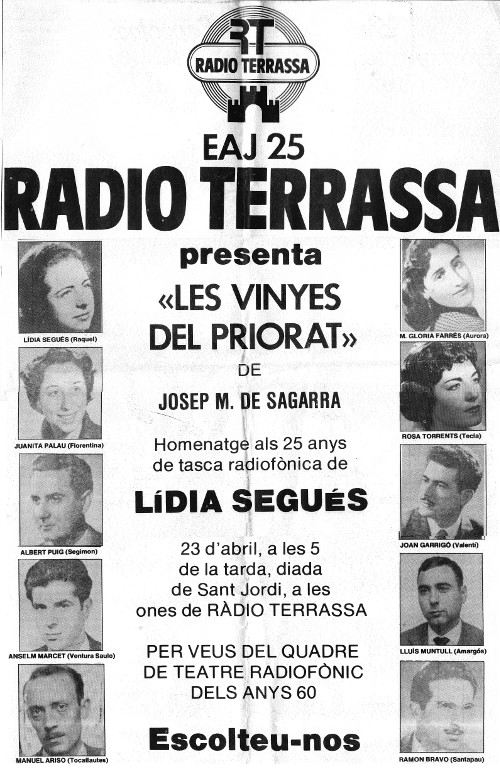
But the disappearance of the Quadre Escènic was only a temporary event. The recovery of radio theatre had its starting point in the wake of a key event. In 1983, Lidia Segués, the station's announcer and radio theatre actress of the 1950s, who had started at the Quadre Escènic in 1951 but did not become part of the announcers' staff until 1957, celebrated her 25 years of radio work. For this occasion, a group of former colleagues from the Quadre Escènic from the previous stage paid tribute to her with the performance of "Les vinyes del Priorat" by Josep Maria de Sagarra, a work that she herself had already performed in the previous stage and in which she is participating again. Maria Glòria Farrés, Juanita Palau, Albert Puig, Anselm Marcet, Manuel Arisó, Rosa Torrens, Ramon Bravo, Lluís Montull and Joan Garrigó participated alongside her.
Aquesta celebració torna a despertar la inquietud del teatre radiofònic a tots ells, de manera que, d'acord amb la direcció de l'emissora, es tira endavant un nou projecte per reactivar el Quadre Escènic. Les noves sessions de radioteatre, que al principi s'ofereixen amb caràcter bimensual, compten amb les veus encara actives de l'etapa anterior, però també s'hi afegeixen noves veus més joves. La direcció d'aquest Quadre de Veus s'encomana a Joan Garrigó, i Rafael Peris assumeix la tasca d'adaptador i guionista de les obres que es posen en antena. D'aquesta manera es forma un grup estable i totalment amateur que segueix una disciplina i serietat que permet complir els objectius establerts i oferir un producte de qualitat a l'audiència. Així, amb la col·laboració desinteressada de tots els seus components, aquest Quadre de Veus és converteix en una oferta única dins el panorama radiofònic del moment, ja que les iniciatives d'altres emissores per reviure el Els components del Quadre de Veus de Radioteatre, el 1.986teatre radiofònic, han topat amb la dependència professional dels seus actors i ho han estat capaces de continuar endavant.

1986
Quadre de Veus eis growing
From 1986, with the Quadre de Veus already consolidated, the offer of retransmissions was expanded and works were broadcast on a monthly basis, on the last Saturday of each month. From that moment on, the Quadre de Veus began a prolific stage of creation and interpretation of different works, such as "La fortuna de Sílvia" and "La ferida lluminosa" by Josep Maria de Sagarra; "Ball robat" by Joan Oliver; "Crime and Silence" by Josep Comas i Tàpies; "La puntaire" by Salvador Bonavia; "La puebla de las mujeres" by the Alvarez Quintero brothers; "La madre guapa" by Adolfo Torrado; "Anillos para una dama" by Antonio Gala; "Los tres etcéteras de Don Simón" by José Maria Pemán; "Proceso a cuatro monjas" by Vladimiro Cajoli; "La sombra de Caín", the script by the same adapter and scriptwriter of the group Rafael Peris; until reaching the audience success of "Yerma" by Federico García Lorca, in 1988, when the station received numerous letters and telephone calls in sign of approval and congratulations for the work done by the Voice Panel.

1989
The sudden death of Rafael Peris, screenwriter and adapter
In the midst of the artistic stage of the Radio Theatre Voices Group, on February 21, 1989, Rafael Peris, the group's scriptwriter and adapter, died suddenly. A year later, on February 17, 1990 and at the Catholic Social Center, Rafael Peris received an emotional posthumous tribute from his colleagues with the interpretation of "Yerma" by Federico Garcia Lorca in front of a packed amphitheater. This moment also represents the resumption of the radio theatre sessions with an audience that had already been held in the previous stage.

1989
The inn on the air from the radio drama "El pan y la tierra"
A few days after the death of Rafael Peris, Ràdio Terrassa broadcast on March 13, 1989, the serial novel "El pan y la tierra" by the Terrassa author, of Andalusian origin, Angel Cazorla, a radio serial of 52 episodes that had been recorded at the beginning of 1988 and that had a great response.

1990
The Quadre de Veus brings "Yerma" to the stage of Centre Cultural
The good reception of the tribute session to Rafael Peris moved a new representation of "Yerma" to a larger stage, that of the Caixa Terrassa Cultural Center, on November 10, 1990.
Aquesta representació marca l'inicia d'un període de posada en escena de diferents obres i de col·laboració amb diferents entitats per fer lectures dramatitzades.

1990's
Quadre de Veus expands with new actors
In the 1990s, the Quadre de veus continued to offer radio theatre plays on a monthly basis, now with the adaptation and script of Joan Carles Peris, a journalist by profession, who took over the radio adaptations after the death of his father. New voices were also added to the group, until they had an artistic cast of almost forty active voices by the middle of this decade. During this period, some radio theatre performances with an audience were also promoted.

1995
"Agnès de Déu" on stage at Centre Cultural
On January 28, 1995, the Quadre de Veus performed again on the stage of the Cultural Center, in this case, with the interpretation of "Agnès de Déu" by John Pielmeier, achieving a success at the same level as that of the previous performance.

2000's
Performances with an audience continue in different stages
On March 31, 2000, a new work by Federico Garcia Lorca was performed again on the stage of the Cultural Center, in this case, "Bodas de sangre". This was followed by other live performances with an audience, such as "Pygmalion" by Georges Bernard Shaw at the Caixa Cultural Center in Terrassa, or "La mà de mico" by Salvador Vilaregut at the Gran Casino.

2000's
The beginning of 21st Century
During these first years of the 21st century, the Quadre de Veus continues to incorporate new actors and actresses into its cast, and works such as "Bajarse al moro" by José Luis Alonso de Santos, "El banyut imaginari" by Molière, "El proceso de Oscar Wilde" by Maurice Ronstad, "El zoológico de cristal" by Tennessee Williams, "Escuadra hacia la muerte" by Alfonso Sastre, "Fulgor y muerte de Joaquín Murieta" by Pablo Neruda, "L'assassinada de la senyora Abril" by Josep Maria de Sagarra, "L'habitación" by Harold Pinter, "La casa de Bernarda Alba" by Federico García Lorca, among others, are performed.

2004
The challenge of "La sentencia se cumplirà a las doce"
On January 16, 2004, as part of the celebrations for the 75th anniversary of Ràdio Terrassa at the Teatre Alegria, the Quadre de Veus staged a double program. On the one hand, the re-enactment of the script by W.W. Jacobs, "The Hand of the Monkey", which had already been staged previously; and on the other, the staging of "The Sentence Will Be Executed at 12", a script specially designed for radio written by the legendary scriptwriters Juan Manuel Soriano and Ramon Vaccaro of the Radioteatro and Teatro Invisible of Radio Nacional de España. The main challenge of this interpretation is that the story takes place in an exact period of one hour and ends just when the clock strikes twelve. A story that leaves the audience spellbound and with which a high level of interpretation is achieved.

2010
The closure of Radio Terrassa
On January 28, 2010, the imminent closure of Ràdio Terrassa's broadcasts was announced. Two days later, on January 30, the last play on this station was broadcast, "Cándida" by Bernard Shaw, which also became the last local production space to be broadcast on Ràdio Terrassa. This marked the beginning of a brief period of absence of radio theatre on the airwaves, but not of the activity of the Quadre de Veus, which continued to maintain the commitments acquired with the different organizing entities of the events that were already scheduled.

2010
The beginning of the new stage at 95.2 Ràdio
The manifest will of the group's members for the continuity of radio theatre and the interest shown by different organizations to keep radio theatre alive, are translated into First logo of the "Radiofònic Theatre" on 95.2 Ràdio.a total collaboration agreement between the Quadre de Veus and the Municipal Radio of Terrassa that was conceived during the month of July 2010. Thus, on September 25, with the start of the new radio season, the Quadre de Veus de Radioteatre, began its activity on this station with the interpretation of the play "L'hostalera" by Carlo Goldoni. Since then, the artistic cast takes the name of this station and becomes known as the Quadre de Veus de Radioteatre de la 95.2 Ràdio.

2015
The Teatre Radiofònic recovers historical recordings
The first five seasons on 95.2 Ràdio, the Radiofònic Theatre was broadcast monthly. From the 2015-2016 season until 2022 - 2023, the Radiofònic Theatre is broadcast weekly, combining new recordings with the broadcast of old works that are preserved from the years of the second stage of Ràdio Terrassa, reaching a total of more than two hundred broadcasts. From the 2023-2024 season, e4s returns to monthly frequency and is committed to intensifying production and new recordings.